Monday, February 5, 2018

Camille Oreste Chevallier


Recently, a distant relative in France mentioned the name Camille Oreste Chevallier, holder of the Legion of Honor, renewing my interest in the Family Chevallier in Graffigny-Chemin, an ancient and small village traces its existence back to Roman times.

From the online Archives of  Haute Marne and the National Archives in Fontainbleu, concerning the Legion of Merit for Camille Oreste Chevallier, I am able to put together this brief summary:


Camille Oreste Chevallier


Camille Oreste Chevallier is our great uncle.

On the 16th of January, 1852, he was born at home in Graffigny at 5 o’clock in the afternoon. His parents were Paul Constant Chevallier, then 29 years old, and Anne Eugenie Richier, then 23 years old.

Promptly, at 8 am on the following morning, the proud father Paul Constant Chevallier appeared before the mayor of Graffigny-Chemin, his brother Alexander Chevallier, to confirm the birth. Present at the declaration of birth was Hilaire Chevallier, father of Paul, and grandfather to the newborn Camille.

Ten years later, a daughter, Julie Laure Chevallier was born to the couple. She is our great grandmother.

Camille joined the French 1st Mounted Artillery Regiment on the 20th of March 1869, and later served with the 11th Artillery Regiment, achieving the rank of Lt. Colonel and in 1909, receiving for his service the Legion of Honor.


Who is this? 


This leaves unanswered the question of who is this in the photograph. This appears to be a post World War I photograph showing the Croix de Guerre and Battle of Verdun medal.

Qui est-ce?

Tuesday, July 25, 2017

My great gandfather's house

Somewhere in the back of my mind I hear the sweet sound and the lilting lyrics of Judy Collins' Secret Gardens.


Graffigny-Chemin, 1909


Great grandfather's house is still there, but it isn't the same. I drive by and strangers live there. They are kind and invite me in. I go from room to room as we talk. I wish they could see what I see.

"A tangle of summer birds
Flying in sunlight
A forest of lilies
An orchard of apricot trees
Secret Gardens of the heart
Where the flowers bloom forever "

For me, the flowers are the iris and the tree is the sweet fig, the images I forever associate with my grandparents' house in Chapel Hill, North Carolina. In my mind's eye, I see playing on the hills overlooking Graffigny, two small girls, ages nine and seven, my grandmother Marguerite and her sister Paula, laughing and arms stretched out, jumping up and grabbing fistfuls of cherries from the low hanging branches, eating most but saving some, so that their mother Laure* will make them a pie for dinner.

The postcard above was taken on the occasion of the beatification of Jeane d'Arc in 1909.  Shown on the left behind the wall is the carriage house of my great grandfather Charles William Christian Meine and his wife Julia Laure Emma Chevallier.

great grandmother Julia Laure Emma Chevallier and her house in Graffigny


 (*I call her Laure and not Julia since the initials over the front door are C & L, for Charles and Laure)

Saturday, December 13, 2014

Rue du Chêne

Rue du Chêne (Oak Street) 
Rue du Chêne,Graffingy-Chemin

On the street where my grandmother lived in 1909. looking north towards the church of  St. Elophe and St. Christophe.

Une autre vue, Rue du Chêne, Graffingy-Chemin, dans la rue où vivait ma grand-mère, 1909.
Peut-on me dire la direction de la rue? L'église est à droite.


Rue du Chêne,Graffingy-Chemin

Tuesday, January 28, 2014

Anne Marie Richier

Anne Marie Richier, daughter of Thomas Richier and Jeanne Morel, was born 6 April 1829 in Graffigny-Chemin, France.

Anne Marie Richier, born April 6, 1829


Archives de la Haute-Marne

Anne married Paul Constant Chevallier.

Anne Marie Richier married Paul Constant Chevallier, 21 April 1847


The way they were

The period from 1830 to 1848, roughly the time between the birth of Anne Richier and her marriage to Paul Constant Chevallier, was known as the July Monarchy. France was ruled by a monarch, Louis-Philippe, crowned "King of the French", signifying his popular sovereignty. Louis-Philippe owed his crown to the rising middle class, les bougoises. With the exception of Algeria, Louis-Philippe's policies with regard to business and foreign policy were free of government involvement, laissez-faire.

The records of the Archives de la Haute-Marne, during this period, reference the class and status of the individuals who are born, marry, and die in the villages of France. Thus, one often sees the descriptions marchand (merchant) , proprietor (property owner), laboreaux (laborer), and sans profession (unemployed) in the village records.

During this period, France was experiencing a population splurge with most of the births occurring in the countryside. Even with the deaths that occurred as a result of the Napoleonic wars, France was second in population (behind Russia) in Europe. If we go back briefly in time, Hilaire Chevallier and Margaret Collin, the parents of Paul Constant Chevallier, recorded four births during the short period 1813 - 1822.

detail, births Graffigny-Chemin, 1813 -1822

Monday, January 27, 2014

The potato famine

The potato blight struck Europe in the mid-1840s. In Ireland more than one million individuals died of starvation, but its effects were also felt in France and in the village of Graffigny, as the following image reveals. The famine lead to a worsening economy and then to the overthrow of Louis Philippe in February 1848. The Second Republic of France followed.

Deaths 1847, Graffigny
The recorded deaths in Graffigny for the year 1847 exceed the normal mortality rate for a village or two to three hundred individuals. Also striking is the number of individuals from the same family.

Archives de la Haute-Marne, 1843-1852

Paul Achille Chevallier was the seven year old son of Claude Alexandre Chevallier and Genivieve Rouyer.

Paul Achille Chevallier

Joseph Chevallier died at the age of seventy, a former military officer, son of Joseph Chevallier and Marie Collin.

Joseph Chevallier, died 1847


Sunday, January 26, 2014

Marguerite Collin Chevallier


Marguerite Collin Chevallier (wife of Hillaire Chevallier) died May 9, 1876 at the age of 92. She was born in 1882. Hillaire and Marguerite had a son, Paul Constant Chevallier, father to Julie Chevallier, mother of Marguerite Chevallier Meine, who is my grandmother.

Archives Haute-Marne, 1843-1852

Charles Hippolyte Chevallier

[Hilaire Chevallier is father of Paul Constant Chevallier, father of Julie Chevallier, mother of Marguerite Chevalier Meine, mother of Elmire Pearson, my mother.]


Children of Hilaire Chevallier and Marguerite Collin Chevallier include:

Charles Hippolyte Chevallier (older by five years)
Paul Constant Chevallier

...


Charles Hippolyte Chevalier married Elise Victoire Journieaux the 10th of May, 1876. Charles was 60 years of age at the time and Elise was 32. Charles was born in 1815, the same year as the battle of Waterloo. Charles' father was Hilaire Chevallier, his mother was Marguerite Collin. Hillaire died in 1852, Marguerite was 84 at the time of her son's marriage.

This information comes from the Archives Haute Marne.

Side note. One of the stain glass window in the chuch of St. Elophe and St. Christophe was donated by Madame Charles Hippolyte Chevallier.

Church of St Elophe et St Christophe, Graffigny,
donation Elise Victoire Journieaux Chevallier


list of weddings Graffigny 1876


marriage Charles Hippolyte Chevallier and Elise Victoire Journieaux

Note to self. No births recorded in the parish records 1873 -1882. One marriage, that of Charles Chevallier to Elise Journieaux from Rocquigny.

Sunday, September 15, 2013

Voie Romaine

The fall of the Western Roman Empire occurred on September 4, 476, when Romulus Augustus, the last Emperor, was deposed by Odoacer. Even then and for a thousand years afterwards, overland trade in France followed the old familiar Roman roads known as the Voie Romaine (Roman Way).


Voie Romaine, around Langres
and northeast to Solimariaca (Soulosse)
 on the route to Trier
[Image French National Library, Carte des voies romaines du Département de la Haute-Marne 20 Lieues gauloises / Th. Pistollet de St. Ferjeux del., 1860. Map detail shows the route north from Langres past Graffigny-Chemin to Soulosse-sur-St-Elpohe. The route continues to Trier.

In Roman Gaul a system of roads was organized in the decades before Christ by Marcus Vipsanius Agrippa around Lugdunum (Lyon). The collection became known as the Via Agrippa (Road Agrippa) and contained over 21,000 kilometres (13,000 miles) of paved stone roads. One route, beginning in Lyon, goes north  270 kilometers (170 miles) to Langres. At Langres it branches. One branch goes northwest to Reims, the other north and east to Toul, then further north to Trier.

The Roman Way to Toul and passes through the village of Graffigny-Chemin. Indeed, as one drives north through Chemin, the road will be marked as Voie Romaine.
heading north on the Voie Romaine, church of St Nicolas de Chemin
[Images of Graffigny-Chemin downloaded from Google Earth.]


Graffigny-Chemin's location is well-situated as a way station on the route. Then, as now, it lies 60 kilometers north of Langres, capital of the Gallic tribe the Lingones, and a further 70 kilometers north to Toul, capital of the Leuci. (In Commentaries on the Gallic Wars, Julius Caesar mentions both Lingones and Leucis.)

From Langres to Toul, it is about 125 kilometers (about 80 miles). This would be about 4 days travel for a Roman legion or those who followed in their footsteps: bishops making parochial visits, priests, wandering minstrels, students, tinkers, merchants, beggars, gentlemen, and those on their way to the various fairs of medieval Europe.

The trip to Graffigny-Chemin is about half that distance, or two days out either way. Graffigny-Chemin possesses a spring for water (the well for the spring water is still found outside the Church of St.Christophe and St. Elophe) as well as nearby fields where traveling merchants could rest by the roadside for the night while their animals grazed.

view of the Church of St. Christophe and St. Elophe, Graffigny


Only the well-to-do and soldiers rode, everyone else walked. Those who walked would have to put up with the horse droppings, and make way for horse and cart. One imagines that, like in Chaucer's Canterbury Tales, the commoners known as the pied "dusty feet" would seek out fellow travelers for companionship. If there were houses in the location where Graffigny and Chemin now stand, it is not hard to imagine that they served as a guesthouse or an inn.

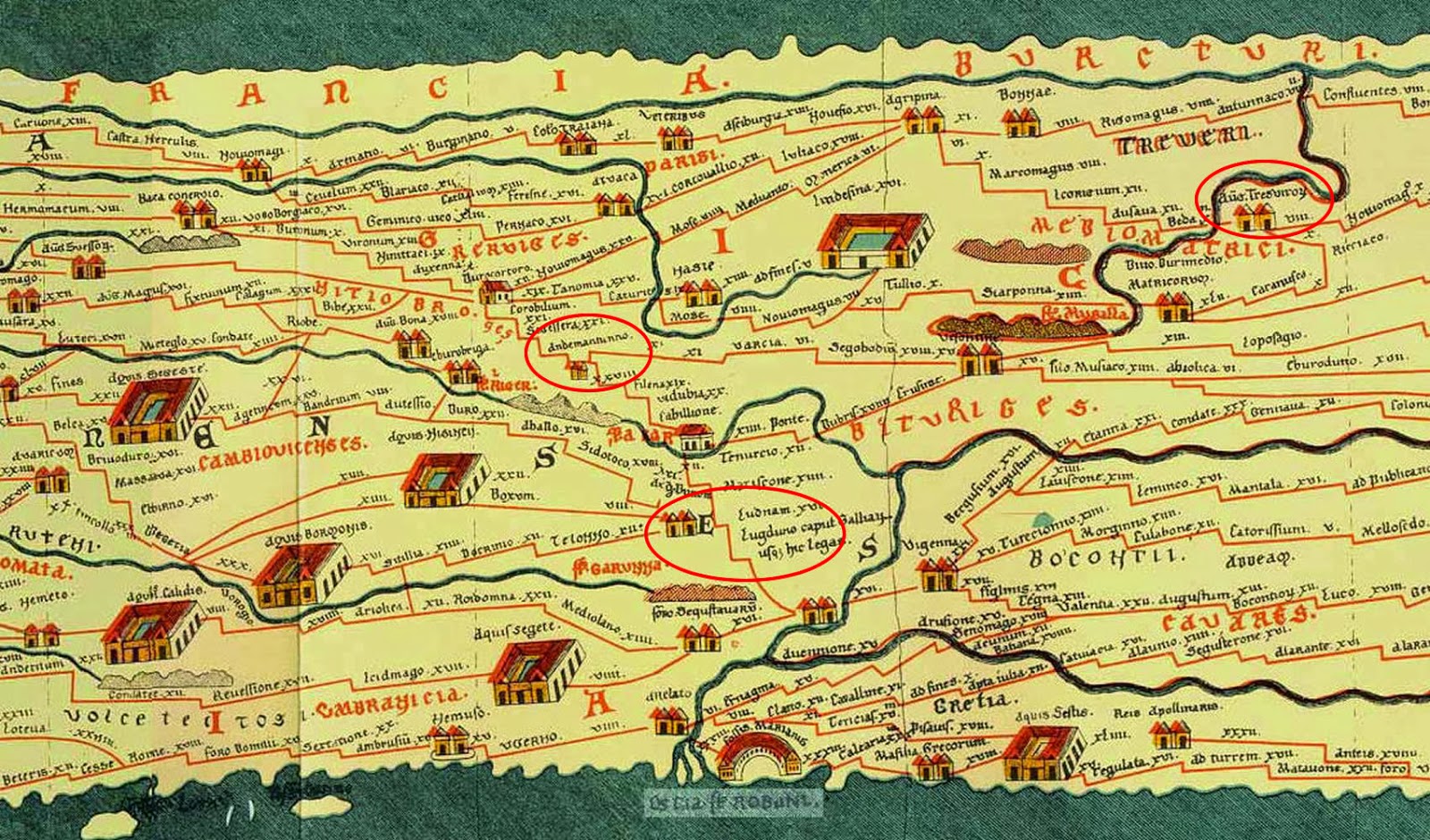
detail Tabula Peutingeriana Francia


The Peutinger Table was drawn in 1265 by a monk from Colmar, but its information dates back at least to before 79 AD since Pompeii is included. Moreover, Cologne is identified as Agripina, the Roman general who under Octavian, organized the roads in Gaul into a system collectively known as the Via Agippina.

The detail above shows the route from Lyon, capital of Gaul, to Langres, then to Neufchateu (Noviomagnus) and Toul (Tullio). From Toul the route crosses the Moselle River at Dieulouard, Meurthe-et-Moselle (Scarponna) before going on to Trier (Tresviroy).

More info on the map.


Wednesday, April 3, 2013

Marguerite Chevallier Meine


My grandmother was French, so she said.

Ma grand-mère était française, disait-elle.

Marguerite Chevallier
I was perhaps ten when I first recall seeing her. She spoke in a French accent even after 30 years of speaking English. Her maiden name, as I knew it as a child, was Marguerite Chevallier. And when she spoke of Germans, it was always with a touch of disdain. The few bits and pieces of history that I recall her telling me as a child include her parents hiding silver and valuables from the Germans during the Franco-Prussian War, and then the devastating consequences of the First World War on Graffigny-Chemin, the small village in Haute-Marne, formerly the province of Lorraine, where she and her sister grew up with their mother.

 J'avais dix ans quand je l'ai vu la premier fois. Elle parlait anglais avec un accent français fort. Son nom de jeune fille, comme je l'ai connu par enfant, était Marguerite Chevallier. Et quand elle parlait aux Allemands, c'était toujours avec une touche de dédain. Les quelques bribes de l'histoire que je me souviens qu'elle me dit comme un enfant comprennent cacher l'argent des Allemands pendant la guerre franco-prussienne, et puis les conséquences dévastatrices de la Premier Guerre mondiale. Graffigny-Chemin, où elle et sa soeur ont grandi avec leur mère, estais une petit village dans le Haute -Marne, la province de Lorraine ancienne.

Madison Pearson's 2nd Division Campaign medal
My grandmother met my grandfather in France in January of 1918. He was serving with Second Division, later the Third Division, near Graffigny. Indeed, when he first arrived, he was billeted in the town of Graffigny, as the Second Division was headquartered in the nearby town of Bourmont. The family history is that my grandfather, Madison Pearson, was injured in one of the many battles and nursed back to health by my grandmother. There are no military records of his exploits, so that can not be documented. What I do know is that my grandfather has several medals including, a Purple Heart that proves he was wounded, and the Silver Star, that shows he fought with gallantry in action. 

Ma grand-mère a rencontré mon grand-père en France en 1917. Il servait près de Graffigny, dans la deuxième division, et plus tard la troisième division. Quand il est arrivé, il était cantonné dans la ville de Graffigny, comme la deuxième division a son siège social dans la ville voisine de Bourmont. L'histoire de la famille, c'est que mon grand-père, Madison Pearson, a été blessé dans l'une des nombreuses batailles et ramené à la santé de ma grand-mère. Il n'existe aucune documents militaires. Mais, ce que je sais, c'est que mon grand-père a plusieurs médailles dont une Purple Heart qui prouve qu'il a été blessé, et la Silver Star, qui montrent qu'il a combattu avec bravoure au combat.

Marguerite Chevallier Meine

My grandmother and grandfather somehow found time during the progress of the war to court, and after the armistice in November of 1918, they married. Eventually, they returned to the United States. My grandfather remained in the military retiring as a Brigadier General. 


Mon grand-mère et grand-père a trouvé le temps à la cour pendant la guerre, et après le fin de guerre, ils se sont mariés. Finalement, ils sont retournés aux États-Unis. Mon grand-père est resté dans l'armée sa retraite comme général de brigade. 


My visits as a teenager to their home in Chapel Hill, North Carolina were always enjoyable. I remember the purple irises that lined the stone driveway to their house. I enjoyed the fried chicken and Spanish rice my grandmother loved to cook. I played cards with both my grandparents, Canasta with my grandmother, and bridge with my grandfather.


Mes visites à l'adolescence dans leur maison à Chapel Hill, Caroline du Nord étaient toujours très agréables. Je me souviens des iris violets qui bordaient l'allée de pierre de leur maison. J'ai apprécié le poulet frit et riz à l'espagnole ma grand-mère aimait cuisiner. J'ai joué aux cartes avec mes deux grands-parents, Canasta avec ma grand-mère, et pont avec mon grand-père.

There was a garden in the back of the house which had lost much of its splendor with the passing of years. My grandparents, now in their seventies, had slowed down. Still, it was fun to explore the garden with its chicken coup, its trellises, its water pond, the fig tree, and crushed stone pathways that were lined with ancient flower beds gone to seed.

Il y avait un jardin à l'arrière de la maison qui avait perdu un peu de sa splendeur au fil des ans. Mes grands-parents, maintenant septuagénaires, avait ralenti. Pourtant, il était amusant d'explorer le jardin avec son poulailler, ses treilles, son bassin d'eau, et les voies qui ont été bordée de parterres de fleurs anciennes.

All family histories are a mixture of memories both sweet and sad. Our grandparents pass on as do our parents, and we are left with but a few things to remember them by.

Les histoires de toutes familles sont un mélange de souvenirs doux et triste. Nos grands-parents se transmettent comme nos parents, et nous nous retrouvons avec quelques petites choses à leur souvenir.

My grandmother was French, as I said, but there is always more to the story…

Ma grand-mère était française, comme je l'ai dit, mais il ya toujours plus à l'histoire ...


Saturday, July 7, 2012

Gaul

Gallia est omnis divisa in partes tres. 
De Bello Gallico, Julius Caesar  

 "All Gaul is divided into three parts," Caesar writes, and "one of which the Belgae inhabit, the Aquitani another, those who in their own language are called Celts, in ours Gauls, the third."

Tout étudiants qui ont étudié le latin sont familier avec l'expression 'Gallia omnis divisa intérêt en tres partes'. C'est la première phrase de Guerre des Gaules de Jules César. Et la phrase se termine par, ' un part dont les Belges habitent, les Aquitains l'autre, ceux qui, dans leur propre langue sont appelés Celtes, dans notre Gaulois, le troisième.'

Caesar's Gallic Campaigns online.

Gaul, 1st Century AD


Strabo (58 BC-25 AD) a Greek historian wrote:
"The Gauls add to their natural frankness and ferocity a real thoughtlessness and bragging, as well as a passion for their appearance as they cover themselves with golden jewels, wear golden necklaces around their neck, golden bracelets around their arms and wrists and their chiefs are dressed in clothes with vivid colors and gold brocade. This frivolity is such that victory makes the Gauls insufferably arrogant when defeat leaves them in dismay."
Ammianus Marcellinus (330-400 AD) a Roman historian said:
"The Gauls are generally tall, with white skin, blond hair and frightful and ferocious eyes. Their mood is quarrelsome and extremely arrogant. Any of them in a fight will resist several brawlers at a time with no other help than his wife's, an even more dangerous fighter. Whether calm or wrathful, the Gauls always sound threatening or irritable..."

The several tribes Caesar fought from 58 BC to 50 BC were not barbarians. They had kings and coins, towns and trade. Craftsmen worked metal in bronze and gold. Like all men, they loved their freedom and independence. And they came close to defeating the Roman legions.

In 52 BC,  a young Gallic chieftain, Vercingetorix, united many of the Gallic tribes.  The Lingones with their capital at Andematunnum, modern day Langres, were allied with the Romans. The Roman armies met Vercingetorix at the the siege of Alesia. Victory was often in doubt, but as every scholl child knows the Romans prevailed.

The present day village of Graffigny-Chemin is but one hundred miles from the battle site and less than 40 miles from Andematunnum. Graffigny is indeed along the ancient Roman road that connected the Roman towns of Andematunnum (Langres) and Toul. And the street in Graffigny still bears the name Voie Romaine, Roman Way.

Graffigny-Chemin is off modern Highway A31.

Read more about the Lingones.

Saturday, April 7, 2012

Julie Chevallier Meine

The decades leading up to the First World War were known as the Belle Epoque, the beautiful age. How beautiful was it?

The Franco-Prussian War, which France began and Prussia ended, began and ended in 1870. France's humiliating defeat marked the end of the government of Napolean III and the beginning of  the Third Republic. The peace treaty required France to cede the province of Alsace and much of the ancient province of Lorraine. Graffigny-Chemin was located in Lorraine, then called Haute-Marne. It is the village of my grandmother Marguerite Meine (nee Chevallier).

Defeat brought reform. A new government established a new education system. Railroads were built, the telephone invented, and the camera revealed images of daily life.


Marguerite Chevallier Meine
[Recheck the name Julie Laura Emma Chevallier]

My great grandmother was Julie Laura Emma Chevallier (b.1862). That is a mouthful. There is a saying I heard that mothers and fathers gave their children multiple names to fool the devil. Often the first name was a misnomer, and the child's spoken name would be the second in the series of names given at birth. This was the case with Julie Laura Emma Chevallier. For when I visited Graffigny and went to the house she shared with her husband Charles Meine, over the door, I saw the initials "C & J" which stood for Charles and Julie. 


Julie Laura Chevallier Meine and her two daughters

I have a few pictures of my great grandmother. The above image shows Julie with her two daughters, Paula and Marguerite. Marguerite, on the right, is my grandmother. 


I missed the chance to ask my grandmother about her life in France. I was a teenager when she died and saw her but a few times during her lifetime as my father was in the military. 

Thinking back on the few conversations we had at her house in Chapel Hill, North Carolina, it is surprising now that she was so vehemently anti-German. I say that not because she was French. The French hated Germany for two wars. There was much to hate. But my great grandfather was German. His name was Charles Meine. My grandmother was, as I would learn later, born in Hannover, Germany. The family was well-to-do with business interest in Germany and a vacation home in Switzerland. Charles died before World War I, and Julie raised her children alone, as far as I know.

front door with intials "C & J"


My grandfather James Madison Pearson came to France in 1917. He was part of the American Expeditionary Force, serving with the Second Division, and fighting in several major battles. He was injured, met my grandmother, and they married.

eglise de St.Elophe et St Christophe, Graffigny-Chemin

Julie Chevallier Meine stayed in Graffigny after the war. She was there during the Second World War, and there is a story that she saved the village from destruction by the Germans. See Wikipedia on Graffigny-Chemin. The house that she and her husband lived in Graffigny is still there. It is located across from the church of St. Elophe and St. Christophe. The postcard below shows the street in front of their house and their carriage house behind the wall.


Graffigny-Chemin 1909


Feast of Joan of Arc, 1909, Graffigny-Chemin


Revise

My great grandfather's name was Charles William Meine. I know next to nothing about him. He died before WWI, leaving behind a wife and two daughters in Graffigny. Below are two more images. I presume that they are also of Julie, taken at an earlier date. The one on the left was taken in Meran, Italy near Bolsano. The other was taken in Innsbruck, Austria.


Graffigny-Chemin 1909


La Belle Époque, French for " the Beautiful Era," -  in France the time between 1871 and 1914, the end of the Franco-Prussian War and the beginning of World War I, when life was beautiful, Europe stable, and the world at peace.

My grandmother Marguerite lived in the small village of Graffigny-Chemin with her mother and sister. Marguerite's father, Charles William Meine had passed away, but left the family in comfortable circumstances. He, as I was to learn later, German, though nothing is left of his family records other than an old photograph or two. In 1918. my grandmother married my grandfather, Madison Pearson, an officer with the American army in World War I.

In 1909 Graffigny-Chemin was, as it is now a small village of several hundred souls in the French department of Haute-Marne, formerly the province of Lorraine. Then, as now, it was a farming village with cattle in the pastures, and orchards in the hills behind the village. A stream fed the waterwell in the center of town next to one of two churches that Graffigny had, and across the main square from the house where my grandmother lived with her family. The house where they lived was unlike any other in Graffigny, for it was surrounded by a wall which enclosed the two-story house, a carriage house, and garden.

In April of 1909, Jeanne d'Arc was beatified by Pope Pius X. That event, most likely, inspired the photograph and postcard seen below. And there in the postcard, on the left side is the wall surrounding the home and the carriage house of my grandmother. My grandmother was a young lady at this time. She is perhaps lost in the crowd.


Visit the Orleans Fête de Jeanne d'Arc.

Tuesday, June 21, 2011

Lorraine et Bar Unsolioden


This document, dated mil sept cent quatre vignt nuef, 1789, announces the marriage bans of Nicholas Chevallier and Marguerite Mangeron.

I can read the date of the document, the names, and not much else. Does anyone know the meaning of the stamp "Lorraine et Bar Unsoliden"?

Lorraine was formerly a separate duchy between France and Germany. Bar was also a duchy and was centered on the town of Bar-le-duc. François III Etienne, Duke of Lorraine and of Bar, renounced his rights to the ducal crowns shortly after his marriage to Maria Theresa, future Empress of Austria, in 1736. The deal saw ex-King Stanislaus receive the duchies in 1738 as compensation for losing the throne of Poland. The duchies were a sort of life annuity, with the understanding that they would revert to France at his death.

Unsoliden is German for unsound.

Archive de la Haute-Marne


The Archives de la Haute-Marne are digitalized. The archives contain records of marriages, births, and deaths covering the periods 1586 up until 1912.

In my research, I have come across many names associated with my family. It begins with Chevallier, the name of my great great grandfather, Paul Constant Chevallier. But there are other names to research as well. Paul Constant Chevallier married Anne Marie Richier. Paul's father was Hilaire Chevalllier, who married Marguerite Collin. Then too, there are the surnames Morel, Rouyer, and Ligier, but I will have to come back to these.

Chevallier is a name which is sprinkled throughout the archives for hundreds of years. I have mentioned Paul's father, Hilaire, but there are also the names of Nicolas, Joseph, Paul Achille, Claude, Charles Hippolyte, and more whose relationship is not always clear.


______________________________________________________________

What follows is a cursory review of the archives for the period 1893 - 1902. This should find a new page.


The Archives of Haut-Marne, births, marriages, and deaths. Select d’état civil. Graffigny today is a village of perhaps two to three hundred souls. The archives suggest that the population has not changed much.


Year Births Marriages Deaths Arch/Pages
1893
1894
1895
1896
1897
1898
1899
1900
1901
19
10
10
10
20
14
21
15
x
8
8
10
1
5
9
5
7
x
13
13
10
13
8
22
21
10
x
-
-
-
60
75
93, 94
112, 113
126
x

Years 1893 to 1895:

Summaries by year of births are found at pages 7, 24, 40

Summaries by year of marriages and divorces are found at pages 15, 30 and 31, 49

Summaries of deaths xx, 35, 52,

Beginning in 1896, births, marriages, divorces and deaths are summarized together. Pages 60, 75,

1896, death of Claude Alexandre Chevallier, born 1810, age 87, son of Hilaire Chevallier and Marguerite Collin, deceased. His wife Marie Genevieve Rouyer, deceased 1889.  Father of Edmond Chevallier, "le premier gendre et le second neveau" (page 56). Note by me, brother of Paul Constant Chevallier.(page 56).

Notes.

1893, Marie Jean-Marcel born 8 May, 1893.son of Marcel Edmond Chevallier and  Eugenie Denise Moirot, both age 33, witnessed by Paul Constant Chevallier, age 70, and Ernest Chevallier, age 44 (page 3).

1893, marriage of Paul Ernest and Marie Hortense Demay April 4, 1893.Paul Ernest, age 46, is the oldest son of Paul Constant Chevallier and Anne Marie Richier. Anne Marie Hortense Demay, age 46, is the daughter of Antoine Demay, deceased, and Marie Collin, age 70 (page 10).

1897. Typewriter used for the first time, although many entries remain handwritten.

1897, Cecile Richier, age 91 deceased. He was born the 27th Brumaire, the 14th of the Republic. Note by me, Brumaire refers to the second month of the French Republican calendar, so named for the fog that often occurs at that time of year. Question, is the scribe repeating the language of Cecile's birth for the year 1805-6? ... Son of Nicholas Richier (died 1853) and Marie Magdeline Quentin (died 1870). Spouse "vuive" ??? of Lemoine Nicholas Antoine. ??? Note by me. I have included Cecile Richier only because of the possible connection with Anne Marie Richier, wife of Paul Constant Chevallier.

1898, Paul Albert Chevallier died 21 October, age 13, son of Paul Ernest Chevallier and Zepherine Douzery (page 90).

Monday, June 20, 2011

Summary of Births and Deaths, 1853 - 1862

Births Deaths
1853 - 20
1854 - 16
1855 - 20
1856 - 16
1857 - 12
1858 - 4
1859 - 25
1860 - 19
1861 - 22
1862 - 16

1853 -

Mayor of Graffigny is Alexandre Chevallier.

Births are summarized by year in the Archives at pages 8, 14, 20, 27, 32, 38, 49, 55, 63, 69,

Notes.
1854, Constant Trenie ??? Berliz Chevallier born January 9, son of Paul Constant Chevallier, 31, and Eugenie Richier, 25 (page 9).

1856, Charles Hypolite Armand Chevallier born June 25, son of Paul Constant Chevallier, age 34, proprieter and cultivator, and Anne Marie Richier, age 27, (page 24).


1859, Marcel Edmond Chevallier born March 18, son of Paul Constant Chevallier, 37, and Anne Marie Richier, 30 (page 40).

1862, Julie Laure Emma Chevallier born march 14, daughter of Paul Constant Chevallier, 40, and his wife, Anne Marie Richier, 33 (page 66).A later note lists Julie's death occurring March 25, 1956 in Neufchateau, Vosges.


Note. For a discussion of fertility rates in France during the 1800's, see http://hailtoyou.wordpress.com/2011/02/20/why-did-french-fertility-collapse-in-the-1800s/.