Showing posts with label graffigny-chemin. Show all posts

Saturday, December 13, 2014

Rue du Chêne

Rue du Chêne (Oak Street) 
Rue du Chêne,Graffingy-Chemin

On the street where my grandmother lived in 1909. looking north towards the church of  St. Elophe and St. Christophe.

Une autre vue, Rue du Chêne, Graffingy-Chemin, dans la rue où vivait ma grand-mère, 1909.
Peut-on me dire la direction de la rue? L'église est à droite.


Rue du Chêne,Graffingy-Chemin

Monday, January 27, 2014

The potato famine

The potato blight struck Europe in the mid-1840s. In Ireland more than one million individuals died of starvation, but its effects were also felt in France and in the village of Graffigny, as the following image reveals. The famine lead to a worsening economy and then to the overthrow of Louis Philippe in February 1848. The Second Republic of France followed.

Deaths 1847, Graffigny
The recorded deaths in Graffigny for the year 1847 exceed the normal mortality rate for a village or two to three hundred individuals. Also striking is the number of individuals from the same family.

Archives de la Haute-Marne, 1843-1852

Paul Achille Chevallier was the seven year old son of Claude Alexandre Chevallier and Genivieve Rouyer.

Paul Achille Chevallier

Joseph Chevallier died at the age of seventy, a former military officer, son of Joseph Chevallier and Marie Collin.

Joseph Chevallier, died 1847


Sunday, September 15, 2013

Voie Romaine

The fall of the Western Roman Empire occurred on September 4, 476, when Romulus Augustus, the last Emperor, was deposed by Odoacer. Even then and for a thousand years afterwards, overland trade in France followed the old familiar Roman roads known as the Voie Romaine (Roman Way).


Voie Romaine, around Langres
and northeast to Solimariaca (Soulosse)
 on the route to Trier
[Image French National Library, Carte des voies romaines du Département de la Haute-Marne 20 Lieues gauloises / Th. Pistollet de St. Ferjeux del., 1860. Map detail shows the route north from Langres past Graffigny-Chemin to Soulosse-sur-St-Elpohe. The route continues to Trier.

In Roman Gaul a system of roads was organized in the decades before Christ by Marcus Vipsanius Agrippa around Lugdunum (Lyon). The collection became known as the Via Agrippa (Road Agrippa) and contained over 21,000 kilometres (13,000 miles) of paved stone roads. One route, beginning in Lyon, goes north  270 kilometers (170 miles) to Langres. At Langres it branches. One branch goes northwest to Reims, the other north and east to Toul, then further north to Trier.

The Roman Way to Toul and passes through the village of Graffigny-Chemin. Indeed, as one drives north through Chemin, the road will be marked as Voie Romaine.
heading north on the Voie Romaine, church of St Nicolas de Chemin
[Images of Graffigny-Chemin downloaded from Google Earth.]


Graffigny-Chemin's location is well-situated as a way station on the route. Then, as now, it lies 60 kilometers north of Langres, capital of the Gallic tribe the Lingones, and a further 70 kilometers north to Toul, capital of the Leuci. (In Commentaries on the Gallic Wars, Julius Caesar mentions both Lingones and Leucis.)

From Langres to Toul, it is about 125 kilometers (about 80 miles). This would be about 4 days travel for a Roman legion or those who followed in their footsteps: bishops making parochial visits, priests, wandering minstrels, students, tinkers, merchants, beggars, gentlemen, and those on their way to the various fairs of medieval Europe.

The trip to Graffigny-Chemin is about half that distance, or two days out either way. Graffigny-Chemin possesses a spring for water (the well for the spring water is still found outside the Church of St.Christophe and St. Elophe) as well as nearby fields where traveling merchants could rest by the roadside for the night while their animals grazed.

view of the Church of St. Christophe and St. Elophe, Graffigny


Only the well-to-do and soldiers rode, everyone else walked. Those who walked would have to put up with the horse droppings, and make way for horse and cart. One imagines that, like in Chaucer's Canterbury Tales, the commoners known as the pied "dusty feet" would seek out fellow travelers for companionship. If there were houses in the location where Graffigny and Chemin now stand, it is not hard to imagine that they served as a guesthouse or an inn.

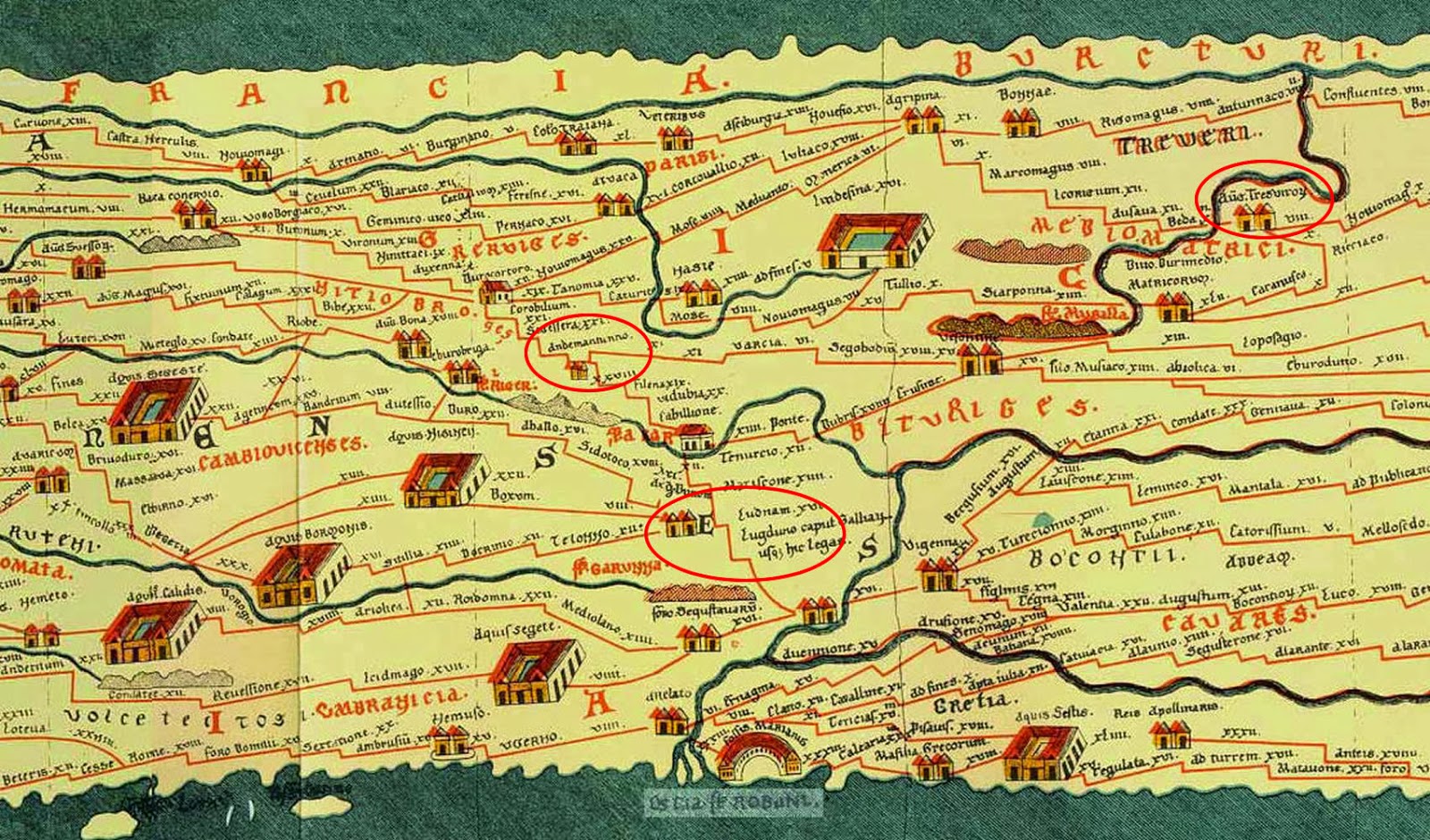
detail Tabula Peutingeriana Francia


The Peutinger Table was drawn in 1265 by a monk from Colmar, but its information dates back at least to before 79 AD since Pompeii is included. Moreover, Cologne is identified as Agripina, the Roman general who under Octavian, organized the roads in Gaul into a system collectively known as the Via Agippina.

The detail above shows the route from Lyon, capital of Gaul, to Langres, then to Neufchateu (Noviomagnus) and Toul (Tullio). From Toul the route crosses the Moselle River at Dieulouard, Meurthe-et-Moselle (Scarponna) before going on to Trier (Tresviroy).

More info on the map.


Wednesday, April 3, 2013

Marguerite Chevallier Meine


My grandmother was French, so she said.

Ma grand-mère était française, disait-elle.

Marguerite Chevallier
I was perhaps ten when I first recall seeing her. She spoke in a French accent even after 30 years of speaking English. Her maiden name, as I knew it as a child, was Marguerite Chevallier. And when she spoke of Germans, it was always with a touch of disdain. The few bits and pieces of history that I recall her telling me as a child include her parents hiding silver and valuables from the Germans during the Franco-Prussian War, and then the devastating consequences of the First World War on Graffigny-Chemin, the small village in Haute-Marne, formerly the province of Lorraine, where she and her sister grew up with their mother.

 J'avais dix ans quand je l'ai vu la premier fois. Elle parlait anglais avec un accent français fort. Son nom de jeune fille, comme je l'ai connu par enfant, était Marguerite Chevallier. Et quand elle parlait aux Allemands, c'était toujours avec une touche de dédain. Les quelques bribes de l'histoire que je me souviens qu'elle me dit comme un enfant comprennent cacher l'argent des Allemands pendant la guerre franco-prussienne, et puis les conséquences dévastatrices de la Premier Guerre mondiale. Graffigny-Chemin, où elle et sa soeur ont grandi avec leur mère, estais une petit village dans le Haute -Marne, la province de Lorraine ancienne.

Madison Pearson's 2nd Division Campaign medal
My grandmother met my grandfather in France in January of 1918. He was serving with Second Division, later the Third Division, near Graffigny. Indeed, when he first arrived, he was billeted in the town of Graffigny, as the Second Division was headquartered in the nearby town of Bourmont. The family history is that my grandfather, Madison Pearson, was injured in one of the many battles and nursed back to health by my grandmother. There are no military records of his exploits, so that can not be documented. What I do know is that my grandfather has several medals including, a Purple Heart that proves he was wounded, and the Silver Star, that shows he fought with gallantry in action. 

Ma grand-mère a rencontré mon grand-père en France en 1917. Il servait près de Graffigny, dans la deuxième division, et plus tard la troisième division. Quand il est arrivé, il était cantonné dans la ville de Graffigny, comme la deuxième division a son siège social dans la ville voisine de Bourmont. L'histoire de la famille, c'est que mon grand-père, Madison Pearson, a été blessé dans l'une des nombreuses batailles et ramené à la santé de ma grand-mère. Il n'existe aucune documents militaires. Mais, ce que je sais, c'est que mon grand-père a plusieurs médailles dont une Purple Heart qui prouve qu'il a été blessé, et la Silver Star, qui montrent qu'il a combattu avec bravoure au combat.

Marguerite Chevallier Meine

My grandmother and grandfather somehow found time during the progress of the war to court, and after the armistice in November of 1918, they married. Eventually, they returned to the United States. My grandfather remained in the military retiring as a Brigadier General. 


Mon grand-mère et grand-père a trouvé le temps à la cour pendant la guerre, et après le fin de guerre, ils se sont mariés. Finalement, ils sont retournés aux États-Unis. Mon grand-père est resté dans l'armée sa retraite comme général de brigade. 


My visits as a teenager to their home in Chapel Hill, North Carolina were always enjoyable. I remember the purple irises that lined the stone driveway to their house. I enjoyed the fried chicken and Spanish rice my grandmother loved to cook. I played cards with both my grandparents, Canasta with my grandmother, and bridge with my grandfather.


Mes visites à l'adolescence dans leur maison à Chapel Hill, Caroline du Nord étaient toujours très agréables. Je me souviens des iris violets qui bordaient l'allée de pierre de leur maison. J'ai apprécié le poulet frit et riz à l'espagnole ma grand-mère aimait cuisiner. J'ai joué aux cartes avec mes deux grands-parents, Canasta avec ma grand-mère, et pont avec mon grand-père.

There was a garden in the back of the house which had lost much of its splendor with the passing of years. My grandparents, now in their seventies, had slowed down. Still, it was fun to explore the garden with its chicken coup, its trellises, its water pond, the fig tree, and crushed stone pathways that were lined with ancient flower beds gone to seed.

Il y avait un jardin à l'arrière de la maison qui avait perdu un peu de sa splendeur au fil des ans. Mes grands-parents, maintenant septuagénaires, avait ralenti. Pourtant, il était amusant d'explorer le jardin avec son poulailler, ses treilles, son bassin d'eau, et les voies qui ont été bordée de parterres de fleurs anciennes.

All family histories are a mixture of memories both sweet and sad. Our grandparents pass on as do our parents, and we are left with but a few things to remember them by.

Les histoires de toutes familles sont un mélange de souvenirs doux et triste. Nos grands-parents se transmettent comme nos parents, et nous nous retrouvons avec quelques petites choses à leur souvenir.

My grandmother was French, as I said, but there is always more to the story…

Ma grand-mère était française, comme je l'ai dit, mais il ya toujours plus à l'histoire ...


Saturday, July 7, 2012

Gaul

Gallia est omnis divisa in partes tres. 
De Bello Gallico, Julius Caesar  

 "All Gaul is divided into three parts," Caesar writes, and "one of which the Belgae inhabit, the Aquitani another, those who in their own language are called Celts, in ours Gauls, the third."

Tout étudiants qui ont étudié le latin sont familier avec l'expression 'Gallia omnis divisa intérêt en tres partes'. C'est la première phrase de Guerre des Gaules de Jules César. Et la phrase se termine par, ' un part dont les Belges habitent, les Aquitains l'autre, ceux qui, dans leur propre langue sont appelés Celtes, dans notre Gaulois, le troisième.'

Caesar's Gallic Campaigns online.

Gaul, 1st Century AD


Strabo (58 BC-25 AD) a Greek historian wrote:
"The Gauls add to their natural frankness and ferocity a real thoughtlessness and bragging, as well as a passion for their appearance as they cover themselves with golden jewels, wear golden necklaces around their neck, golden bracelets around their arms and wrists and their chiefs are dressed in clothes with vivid colors and gold brocade. This frivolity is such that victory makes the Gauls insufferably arrogant when defeat leaves them in dismay."
Ammianus Marcellinus (330-400 AD) a Roman historian said:
"The Gauls are generally tall, with white skin, blond hair and frightful and ferocious eyes. Their mood is quarrelsome and extremely arrogant. Any of them in a fight will resist several brawlers at a time with no other help than his wife's, an even more dangerous fighter. Whether calm or wrathful, the Gauls always sound threatening or irritable..."

The several tribes Caesar fought from 58 BC to 50 BC were not barbarians. They had kings and coins, towns and trade. Craftsmen worked metal in bronze and gold. Like all men, they loved their freedom and independence. And they came close to defeating the Roman legions.

In 52 BC,  a young Gallic chieftain, Vercingetorix, united many of the Gallic tribes.  The Lingones with their capital at Andematunnum, modern day Langres, were allied with the Romans. The Roman armies met Vercingetorix at the the siege of Alesia. Victory was often in doubt, but as every scholl child knows the Romans prevailed.

The present day village of Graffigny-Chemin is but one hundred miles from the battle site and less than 40 miles from Andematunnum. Graffigny is indeed along the ancient Roman road that connected the Roman towns of Andematunnum (Langres) and Toul. And the street in Graffigny still bears the name Voie Romaine, Roman Way.

Graffigny-Chemin is off modern Highway A31.

Read more about the Lingones.

Saturday, April 7, 2012

Julie Chevallier Meine

The decades leading up to the First World War were known as the Belle Epoque, the beautiful age. How beautiful was it?

The Franco-Prussian War, which France began and Prussia ended, began and ended in 1870. France's humiliating defeat marked the end of the government of Napolean III and the beginning of  the Third Republic. The peace treaty required France to cede the province of Alsace and much of the ancient province of Lorraine. Graffigny-Chemin was located in Lorraine, then called Haute-Marne. It is the village of my grandmother Marguerite Meine (nee Chevallier).

Defeat brought reform. A new government established a new education system. Railroads were built, the telephone invented, and the camera revealed images of daily life.


Marguerite Chevallier Meine
[Recheck the name Julie Laura Emma Chevallier]

My great grandmother was Julie Laura Emma Chevallier (b.1862). That is a mouthful. There is a saying I heard that mothers and fathers gave their children multiple names to fool the devil. Often the first name was a misnomer, and the child's spoken name would be the second in the series of names given at birth. This was the case with Julie Laura Emma Chevallier. For when I visited Graffigny and went to the house she shared with her husband Charles Meine, over the door, I saw the initials "C & J" which stood for Charles and Julie. 


Julie Laura Chevallier Meine and her two daughters

I have a few pictures of my great grandmother. The above image shows Julie with her two daughters, Paula and Marguerite. Marguerite, on the right, is my grandmother. 


I missed the chance to ask my grandmother about her life in France. I was a teenager when she died and saw her but a few times during her lifetime as my father was in the military. 

Thinking back on the few conversations we had at her house in Chapel Hill, North Carolina, it is surprising now that she was so vehemently anti-German. I say that not because she was French. The French hated Germany for two wars. There was much to hate. But my great grandfather was German. His name was Charles Meine. My grandmother was, as I would learn later, born in Hannover, Germany. The family was well-to-do with business interest in Germany and a vacation home in Switzerland. Charles died before World War I, and Julie raised her children alone, as far as I know.

front door with intials "C & J"


My grandfather James Madison Pearson came to France in 1917. He was part of the American Expeditionary Force, serving with the Second Division, and fighting in several major battles. He was injured, met my grandmother, and they married.

eglise de St.Elophe et St Christophe, Graffigny-Chemin

Julie Chevallier Meine stayed in Graffigny after the war. She was there during the Second World War, and there is a story that she saved the village from destruction by the Germans. See Wikipedia on Graffigny-Chemin. The house that she and her husband lived in Graffigny is still there. It is located across from the church of St. Elophe and St. Christophe. The postcard below shows the street in front of their house and their carriage house behind the wall.


Graffigny-Chemin 1909


Feast of Joan of Arc, 1909, Graffigny-Chemin


Revise

My great grandfather's name was Charles William Meine. I know next to nothing about him. He died before WWI, leaving behind a wife and two daughters in Graffigny. Below are two more images. I presume that they are also of Julie, taken at an earlier date. The one on the left was taken in Meran, Italy near Bolsano. The other was taken in Innsbruck, Austria.


Graffigny-Chemin 1909


La Belle Époque, French for " the Beautiful Era," -  in France the time between 1871 and 1914, the end of the Franco-Prussian War and the beginning of World War I, when life was beautiful, Europe stable, and the world at peace.

My grandmother Marguerite lived in the small village of Graffigny-Chemin with her mother and sister. Marguerite's father, Charles William Meine had passed away, but left the family in comfortable circumstances. He, as I was to learn later, German, though nothing is left of his family records other than an old photograph or two. In 1918. my grandmother married my grandfather, Madison Pearson, an officer with the American army in World War I.

In 1909 Graffigny-Chemin was, as it is now a small village of several hundred souls in the French department of Haute-Marne, formerly the province of Lorraine. Then, as now, it was a farming village with cattle in the pastures, and orchards in the hills behind the village. A stream fed the waterwell in the center of town next to one of two churches that Graffigny had, and across the main square from the house where my grandmother lived with her family. The house where they lived was unlike any other in Graffigny, for it was surrounded by a wall which enclosed the two-story house, a carriage house, and garden.

In April of 1909, Jeanne d'Arc was beatified by Pope Pius X. That event, most likely, inspired the photograph and postcard seen below. And there in the postcard, on the left side is the wall surrounding the home and the carriage house of my grandmother. My grandmother was a young lady at this time. She is perhaps lost in the crowd.


Visit the Orleans Fête de Jeanne d'Arc.

Saturday, August 14, 2010

L'attaque du Moulin

Hate is a strong word. Hate grabs you like a vice. It boils the blood. It is the elixir that turns a rational Dr. Jekyll into a demonic Mr. Hyde.

Hate can flair up in an instance and last a lifetime. I am struck by the number of times that one will say, "I hate you." Child to parent, spouse to spouse, best friend to best friend - hate can flair up over the most trivial of incidents and burn the parties involved forever.

I was perhaps ten or eleven when my grandmother told me that she hated Germans.Well, to be honest, I don't remember her using the word "hate", it was just the intense look on her face when she related a story about the First World War. She was living in Graffigny-Chemin, a small village in Lorraine, France, perhaps 60 miles from the border with Germany. In the telling of the story her face became taut, her voice strident, and she spoke with such a ferocity, that one did not dare question her facts. We simply sat in silence and listened.

Marguerite is a very French sounding name and this was my grandmother's name. My grandfather was James Madison Pearson, which the grandchildren always shortened to Daddy Matt. My grandmother always remained grandmother Marguerite.

She was born in 1890 and although she came from a small village, it is apparent from old photographs that her family was comparatively well off. The village of Graffigny-Chemin is now located in the district of Haut-Marne, but before Napolean it was called the province of Lorraine.Occasionally, the area is still referred to as Lorraine.


The house that her family owned in Graffigny-Chemin was the largest and newest in the village. It was directly across the square from the village church, and during festivals the square was a center of attraction.There was a large garden with a spring attached to the house. And separate from the main house was a carriage house with a large oven where cooking for the house would have occurred. (The carriage house is seen in the left hand side of this postcard from 1909.)


Marguerite father died when she was perhaps thirteen, and so she lived a quiet and idyllic life in Graffigny with her sister Paula and mother Laura. When the First World War came in 1914, both she and her sister were still unmarried.

The war was for her and her family a transforming experience. Marguerite married my grandfather, an American soldier in France, at the end of the First World War and returned to the United States. She spoke English, but always with an accent, so that her stories came across with an air of mystery.


My grandmother's dislike of Germans is not so surprising. France endured three wars in the span of 70 years in which German armies marched into France and caused great destruction and loss of life. Most people are familiar with the two World Wars, starting in 1914 and again in 1939, but few Americans now can recall the Franco-Prussian War of 1870 and 1871, ending in the capture of Napoleon III and a total French defeat. As a result of the treaty terms, Germany gained control of much of the provinces of Alsace and part of Lorraine. It so happened that the village of Graffigny-Chemin, where my grandmother came from, remained French while nearby towns and villages became German.

As I said, Marguerite was born in 1890, but her earliest tales were of the Germans marching through the village of Graffigny during the Franco-Prussian War. She was not yet born, but she told the story with such determination that you could imagine she had lived through it personally.


(Map from Ancestry.com and is used here solely for educational purposes. Graffigny-Chemin and the fictional Roscreuse are added for this article.)

Her family, the Chevallier's, buried the silver and fled to the hills. The silver that was buried in the ground consisted of a set of knives and some candle sticks. That was all.Other valuables were not mentioned. Jewelry or gold, if there was any, was sold off during difficult times. Only the less valuable items remained to become part of the family history.

She spoke with such fierceness that I did not question her further. Or perhaps, I was too shy to ask. Or perhaps, I felt it was not a child's place to question a grandparent. Whatever the reason, I never learned the rest of the story.

This silver was eventually passed down to my mother. While I grew up we used the knives often as they were so sharp as to cut the toughest steak.The handles were silver and the blades made of carbon steel. And at each use I would remember my grandmother's story of her parents hiding the family valuables from the hated Germans.

History should be preserved better. Carbon steel is prone to rusting and the blades needed to be washed and thoroughly dried each time they were used. Instead, the knives, because they cut so easily, were used daily, and then placed in the dishwasher where the water would take its toll on the blades. With each cut of the meat and with each washing, the blades grew smaller and smaller. Blades that once were long and round faded away until only a sliver of steel remained. What the Germans did not steal, our family unknowingly wasted away. What has happened to the knives, I do not know. Perhaps they found their way into a drawer in my sister's house, or worse yet they were discarded as useless. I now have the set of silver candle sticks which adorn my dining room table.

It is tragic that families fail to preserve their treasured memories and stories.Growing up, I regret never asking my grandparents more questions. And with so many siblings and cousins at family gatherings, the moments spent together were more about the young than the old. Being young we wanted to run and play, and not sit and talk. Now that I am older, I long for those stories again.

L'Attaque du Moulin (The attack on the mill) is a short story in French by Emile Zola. The story in French is available for download through InLibroVeritas; it can also be translated using Google Translator. Emile Zola wrote the story in 1880, just ten years after the start of the Franco-Prussian War, when the sting of defeat was still fresh in the minds of the French. Admittedly, the story bears little relationship to the village of Graffigny or to the lives of my grandparents or great grandparents, as far as I know. But, as with all fictional stories - if you read the story carefully and you let your imagination run freely, you can for a moment transport yourself back to another time and place.

The story takes place at the beginning of the war in a fictional village called Rocreuse. Zola places the viollage in Lorraine on the river Morelle. The river like the town is fictional. But there is a river Moselle, a tributary of the Rhine River, which flows through France originating in the Vosges Mountains and joining the Rhine at Koblenz. The river meanders past the French towns of Epinal, Toul, and Metz before crossing back into Germany at Trier. Graffigny is located halfway between Epinal and Toul, and just at the edge of the Vosges Mountains. However, it is not on the river.

At the beginning of story, Merlier, a miller who lives with his daughter Francoise in the only mill in Rocreuse.A party is held and Merlier will betroth his daughter to Dominique, a Belgian man who lives nearby in the forest of Gagny. Zola describes the village and landscape beautifully. It could suffice for a description of Graffigny-Chemin and the famland that surrounds it, with the thick woods that are placed just to the east and north of the village.
" Le village n'a qu'une rue, deux files de masures, une file à chaque bord de la route; mais là, au coude, des prés s'élargissent, de grands arbres, qui suivent le cours de la Morelle, couvrent le fond de la vallée d'ombrages magnifiques.

The village has only one street, two rows of huts, a row each side of the road, but here, at the elbow of the river where the meadows expand, the large trees, which follow the course of the Morelle River, cover the valley in a magnificent shade.

Il n'y a pas, dans toute la Lorraine, un coin de nature plus adorable.

There is not, in all of Lorraine, a corner of nature more adorable.

A droite et à gauche, des bois épais, des futaies séculaires montent des pentes douces, emplissent l'horizon d'une mer de verdure; tandis que, vers le midi, la plaine s'étend, d'une fertilité merveilleuse, déroulant à l'infini des pièces de terre coupées de haies vives. »

To the right and left, thick woods, groves secular rise gentle slopes, filling the horizon with a sea of green, while to the south, the plain stretches from fertility wonderful place to infinite pieces of land cut hedges."
War is cruel. The Germans come to Rocreuse. The mill which stands solidly in the middle of the town becomes both a symbol of strength and then destruction as first the French defend it and then in turn the Germans before it is destroyed by bullets and shells. Peace, tranquility and love all fall victim to war.We are reminded that too often there are greater forces which influence our lives and destinies.

As my grandparents met because of the First World War, I can not say that war is all bad.Certainly we must fight to defend ourselves. And in the process, death is inevitable for the innocent as well as the guilty. However, Zola in this story makes a broader comment on the pointlessness of some wars. In particular, the Franco-Prussian War was started by the French, who lived by a code of honor, and ended by the superior armaments and tactics of the Germans. We should fight for a cause stronger than honor.

As for my grandmother's hatred of the Germans, there must be another story now forgotten. For, you see, my grandmother's father was himself German.

Saturday, July 3, 2010

Missing Person: Elmire Chevallier

My mother's first name was Elmire. She was named after her aunt Elmire Chevallier.

I only learned of the existance of Elmire Chevallier a month ago. I learned of her existence in letters my sister Kathy gave to me. Elmire Chevallier was until then a missing person - missing to me at least and those in my family who did not know of her existence.

The name Elmire is not common. I have never been introduced to another Elmire in my lifetime. I never asked my mother the origin of her name, I just thought it pretty. My father shortened the name Elmire to El, and I thought that pretty too. At first I assumed the name origin as Spanish,  translated as"the sea". I have no basis for saying this other than it sounds poetic. I also fancy that my mother was named for Claude Debussy's beautifully then modern composition La Mer, which was composed in 1903, three years after the birth of my very French grandmother Marguerite Chevallier Meine Pearon.

An etymologist would dispute this interpretation, correcting me by saying that "el mar" is the proper Spanish translation for 'the sea', and that "elmire" translates better as "the view". Further, the word doctor would point out, Elmire is derived from the arabic, Elmira, and means aristocratic lady or princess. With this in mind, I conjure up images of  Arab Moors who swept through Spain in the 11th and 12th centuries and set up castles aand kngdoms in Cordoba, Seville, and Granada. Don't parents always dream images of faraway places and romantic persons when selecting the names of their children?

The name Elmire itself is obscure. The one reference to Elmire I can find is from a character in Moliere's play Tartuffe. The play was written in 1664 and was soon banned by King Louis XIV perhaps because of its racy subject, adultery, but also because the Catholic Church found it was not portrayed favorably. In the play Elmire is the virtuous wife and object of lust by the main character Tartuffe.

My mother's mother was French, and it is not unreasonable to suppose that she was a fan of Moliere. But, the reality is that my mother was named after an aunt, Elmire Chevallier, who lived in Graffigny as did my grandmother. Elmire Chevallier would have been sister to my great grandmother. There still exist several letters between my grandmother Marguerite and her aunt Elmire. Translating them is difficult, not only because of the cursive writing, but also because the long sentences which Elmire was prone to write.

Letters often reveal facts about families that are better left hidden. In letters we reveal our complaints and misfortunes. Keep this in mind for sentences written in haste can be exaggerated or taken out of context.

What I can pick out so far from the letters from Elmire to Marguerite is that there was some dispute as to the family home in Graffigny. So far, I have not found any letters from my great grandmother Laura to her daughter Marguerite. Correspondence seems to have been directred from Marguerite through Elmire to Laura, but whether this correspondence was returned I do not know.

What follows is my translation of a letter from Elmire Chevallier to my grandmother, Marguerite Chevallier Meine Pearson postmarked October 5, 1924. The translation obviously needs improvement and in the future I will photograph and post the actual letter. I will update translation as time allows:


M chere M'ite

Hier apres avoir mise a la porte la lettre que j'adressais a la mere, Marc est entre, comme sa femme m'avais apporte la, fameuse que tu lui a envoyee

My dear Marguerite

Yesterday after having put on the door the letter that I adressed to your mother, Mark came, as his wife had me brings, famous as you sent him

Sunday, March 21, 2010

July 22, 1944

World War II touched the small village of Graffigny-Chemin on the night of July 22 1944 war.

A British Lancaster airplane returning from a bombing mission crashed in a thick fog into the hills outside of Graffigny. Thirteen airmen died in the crash and were buried later in the village cemetery. Three airmen survived the crash. Two were seriously wounded and treated by a doctor from the neighboring town of Bourmont. As their wounds were serious, they were taken to the Germans in hopes with the hope they would be treated well. The two airmen were never heard from again.

A third airman Canadian Paul Bell was hidden in the village of Graffigny-Chemin. He was then escorted to Switzerland by the French. He returned to England and rejoined his unit. Sadly, he died in the liberation of Holland.

Although the plane burned on impact, its radio transmitter, weapons, and some explosives remained intact. Villagers of Graffigny-Chemin removed these before the Germans arrived. On discovering this, the German commander took hostages and threatened to execute the hostages and burn the village if the plane's contents were not returned.

Living in Graffigy-Chemin was the widow of a German colonel who had died in 1913. She interceded with the German commander for the return of the hostages and cancellation of the order to destroy the village.

The story is by way of Dominique Martin.

Thursday, February 18, 2010

Postcards Graffigny-Chemin, l'eglise de St Elophe and St Christophe de Graffigny


 L'eglise de St Élophe et St Christophe a Graffigny

church of Saint Élophe and St Christophe in Graffigny, 1909

This 1909 postcard celebrates the beatification and festival of Jeanne d'Arc  by Pope Pius X. Pictured is the church of Saint Élophe and St Christophe in Graffigny, two unidentified girls stand watching a group of men.

The church is named for the saints, Saint Élophe and St. Christophe. The statutes to the left and right of the entrance are respectively, St. Elophe and St. Christopher. Saint Élophe was a French martyr of the 4th century who was decapitated. St. Christopher is remembered for his act of carrying Jesus across a dangerous river, and, so became the patron saint of travelers. The church is located on the ancient Roman Way (Voie Romaine), travelling north toward Toul, one arrives at the way-station, Soulosse-sur-St-Elophe.

My grandmother was French and she grew up in the village of Graffingy-Chemin, in a house across the street from the church of St. Elophe and St. Christopher. Marguerite Chevallier Meine and her sister Paula grew up in Graffigny.  I am not certain about the birth year, but think that Maurguerite was born in 1890 and Paula in 1888.[Check this.]

The First World War came to Graffigny-Chemin in 1914. My grandfather Madison Pearson came in January of 1918 as part of the American Expeditionary Force and the Second Division. He was billeted in the village, injured near there, and nursed back to health by my grandmother.

They fell in love, married, and returned to the United States.

Monday, September 14, 2009

Time travels


You can go from here to there in seconds.

Here is the computer that you are sitting in front of and there is Graffigny-Chemin, where Marguerite Chevallierwas raised and where she met James Madison Pearson.


Google takes you to the church across the street from where she lived. Observe the carriage house and gardens of her house. In my view, the number 52150 appears on top of the house. A path to the left of the image leads to the hill where I took the view of the village. (See wikipedia entry on Graffigny-Chemin.) The path leading out of the village to the top of the picture goes to Bourmont where during World War I, the Second Infantry Division was originally headquartered. The path leading to the right is the ancient Roman Way from Langres to Toul near the birthplace of Joan of Arc.


Time travels. The past is the compression of all that has happened, waiting to be revealed.

Monday, August 31, 2009

Voie Romaine - Roman Way

Written history of France begins with the Romans.

Julius Caesar in The Conquest of Gaul,  writes that, "[t]he Meuse rises in the Vosges Mountains, in the country of the Lingones." Geographically, he is a bit off, for the Meuse rises on a plateau to the west of the Vosges Mountains, but there is no denying that Graffigny-Chemin is in the area he describes. In 52 BC, at Alesia (Alise-Sainte-Reine) near Graffigny, the Romans fought the Gauls in a life or death struggle. Julius Caesar beat the Gauls under Vercingetorix, bringing France into the Roman world. Had it gone differently, France might have ended up speaking German.

The Lingones like most Gallic tribes were farmers, but possessed at least two cities, Langres and Dijon, and possibly a third at Toul. If one draws a straight line between the ancient Roman cities of Toul and Langres, then midway on the route is the village of Graffigny-Chemin.


Heading north out of the village towards Toul and away from Langres is the route which is still called by its original name "Voie Romaine" or Roman way.

Michelin map of Graffign-Chemin
.

Picture - The ancient Roman way which passes by my grandmother's house in Graffigny and through the neighboring village of Chemin.

Tuesday, August 25, 2009

La maison de ma grand-mere a Graffigny-Chemin

La maison de Graffigny de ma grandmere
 La Maison

One sees in the left corner of the old image, my grandmother's house in Graffigny-Chemin. Standing in front of the carriage house is Laura Chevallier Meine, my great grandmother.The house stands in the main square across from the church seen in the image below.

The picture was taken circa 1909.

On voit de l'avant gauche de la maison de ma grand-mère à Graffigny-Chemin. Debout à gauche de la maison est la mère de ma grand-mère de Marguerite Laura Chevallier Meine. Elle est debout en face de la maison de transport.


La photo a probablement été prise en 1909.

Graffigny-Chemin

Thursday, August 13, 2009

secret gardens of the past


When my grandfather retired from the Army, he and his wife settled down in Chapel Hill, North Carolina. Their house in Chapel Hill was the only house that I knew them in. And even though I only visited twice that I can remember, the memories are still strong.

It was my sister Kathy who observed that Marguerite, our grandmother, brought with her to Chapel Hill her childhood garden in Graffigny-Chemin. The remants of the garden in Grafigny are still there - the walls that enclose the gardens, an old fig tree, the flower beds lined by paths of crushed stone, the places where the arbors once stood with grape vines, and a basin to catch the rain.

Although I was just fifteen the last time I visited my grandparents' home in Chapel Hill, I still vividly remember my grandmother's garden and the stone wall that she and my grandfather built to give the house and gardens a sense of privacy. The wall was too tall for a child to see over, and even years later going back, I am struck by its size and the work that must have gone into building it. There is a shorter wall as one drives into the yard toward the house. Lining the wall are Granny's irises; in spring their stately blooms announce the season and guests alike.


In Graffigny-Chemin the wall is the first thing one notices about the house. The wall surrounds the house and its gardens. Tall and protective, it is designed to shield the people within from the prying eyes of a small village where everyone knows your business.

Granny's garden in Chapel Hill lay in the back of my grandparents' home. Behind the garden was a gravel and dirt road, which served as the hill we took turns riding down in the wagon. But, for the most part, the garden was big enough to keep or attention. A tall fig tree grew; its succulent fruit reminded me of the fig newton cookie I loved then as now. There was an arbor on which grape vines stretched. A deserted chicken coup served as the grandchildren's play house. The paths between the flower beds like the driveway were of crushed stone. Running along the path gave almost the same sound and feel of a rocky beach. There were certainly many flowers, but the only ones I remember were the irises and the tall and stately hollyhocks so common to France.

The garden in Graffigny is also still there, but without full time care, it appears neglected. Forty years have passed since my grandmother died and her sister Paula sold the house in Graffigny. Still, the house is there and the outlines of the garden they once had remain. Flower beds are now separated by boxwood, but laid out along paths that old photographs revealed once were lined with crushed stone. The outlines of two arbors, one overgrown by a tree, the other has long since fallen down and been removed are visible A fig tree stands silently along the wall. And a basin collect the rain water in the garden. The irises which must have one graced the gardens are all gone.

Listen to Judy Collins, Secret Gardens.

What my grandmother would now think? Both in Graffigny and Chapel Hill, the gardens and houses have fallen into disrepair. Time passing is a subject that I think about often.

Judy Collins said it best in Secret Gardens:

"My grandmother's house is still there, but it isn't the same. ...
I drive by the strangers,
And wish that they could see what I see. ...
I still the ghosts of the people I knew long ago. ...
Secret gardens of the heart,
Where the old stay young forever. ...
But, most of all, it is me that has changed. .."

Wednesday, August 12, 2009

From Nancy to Dijon

Before Fodors, Frommer, and all the other travel guides, there was Karl Baedeker. Baedeker's travel guides, along with the touring automobiles of the early 1900's, revolutionized travel and changed the face of Europe. Baedeker wrote many guides, including Northern France which, in part, takes you along the Meuse valley near Graffingy-Chemin.

(Route 38, Pages 302 and 303, first published in 1894 with a second edition in 1909).

Download the pdf. Read the book.

Travel by railroad from Nancy, the historical capital of Lorraine, to Dijon, the capital of Burgundy, a distance of 110 miles or 170 kilometers. This route takes one through the Meuse Valley and near the village of Graffigny-Chemin. The trip by train in 1894 takes only six and one half hours, an average speed of 18 mph, fast considering that automobiles traveled an average of 12mph over the rough dirt roads.

The route heads west from Nancy to the ancient city of Toul, "one of the most ancient towns of the Lorraine, and the seat of a bishop for over 1200 years." (Page 138). The route then swings south to Neufchateau, "a pleasant-looking town ... at the confluence of the Meuse and Mouson." At Neufchateau, "the line ascends the valley of the Meuse, quitting the river for some time beyond Hacourt-Graffigny." In Roman days, the path that connects Graffigny with Chemin was part of the ancient way that connected the Roman cities of Toul and Langres.


Beyond the hills of Graffigny, the train returns to the Meuse Valley, crosses the river and travels on the east bank to Langres, the Roman capital of the Gaullic tribe of Lingones. Graffigny is half way on the trip from Toul to Langres, and Langres is halfway on the trip from Nancy to Dijon.

Julie Laura Emma Chevallier Meine


Julie Laura Emma Chevallier Meine was my great grandmother. Here she is with her two children, my grandmother Marguerite seated on her lap and Paula. (Date circa 1892).

Julie was born in the French village of Graffigny-Chemin on March 16, 1862. She lived in Graffigny thoughout the First World War along with her husband, Charles Guillame Christian Meine. Charles Meine was German, possibly a former colonel, and subsequently a businessman with interests in Hanover, Germany, and Switzerland. He died in 1913 of an unknown cause.

In 1923 Julie departed LeHavre, France for New York. She subsequently returned to Graffigny-Chemin. She was living there at the time of the Second World War.